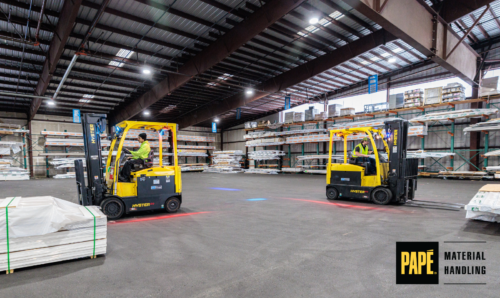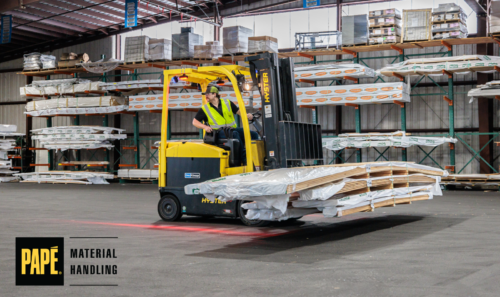

One of the simplest and most inexpensive ways to keep your forklift fleet running effectively and efficiently is to inspect and change out the equipment’s tires regularly. The drawbacks of poor tire fleet management can affect every facet of your business, turning minimal fixes into extended machinery downtime and costly damages. These are the Top 5 Ways Poor Tire Management can affect your business.
1. Operator Comfort & Productivity
Unlike over-the-road trucks, forklifts do not utilize suspension systems with springs or air-ride. Meaning that an average 5,000 lb. capacity forklift when fully loaded has to support over 11,000 lbs. of weight on the front tires. The only cushion or yield the operator has between the ground, and the forklift is the rubber or air of the forklift tires.
After a tire has worn just 40% of its tread, this buffer becomes almost worthless as the driver now absorbs over 84% of the shock running over a rough surface. For operators enduring repeated shifts, this can lead to increased fatigue and stress, which often translates to angry, disagreeable, and unproductive operators. Further impact can potentially compound issues introducing neck or back pain as well as potential safety issues for everyone in the workplace.
2. Increased Maintenance & Operational Costs
As with the impact on employees, a lack of tread can also shorten the life of your equipment. Less traction diminishes the efficiency of the forklift when driving, causing increased heat and fuel costs, as well as wear on the transmission. Additionally, the uneven tire surface can cause the equipment to jar and rock, loosening internal hardware and causing engines to leak and transmissions to overheat.
3. Loss of Stability
Stability can be affected by tire conditions and air pressure, with excessive wear changing the tilt angle of the mast. The change in the maximum tilt angle and instability of the tires can present a tilt-over risk potentially leading to a loss of product or employee injury.
4. Facility Damages
A potential result of the first three issues, there are plenty of integral facility components that are in the line of fire if a forklift loses control. Production machines, door frames, racks, and walls, along with dock and bridge plates, blacktop and concrete could potentially be damaged.
5. Shorter Tire Life
Skimping on higher-quality tires may provide short-term cost benefits, but leads to consistent long-term costs due to lower-quality tires breaking down much faster. You’ll notice the wear through the inevitable skid marks when making turns or moving heavy loads, which are far more apparent with lesser tires.
With Papé as your service provider, you can always expect quality industrial tires readily available through our Mobile Industrial Tire Service. The industrial tires available for forklift applications include rubber press-ons, polyurethane press-ons, rubber pneumatic shaped solids (resilient), bias-ply pneumatics, and radial pneumatics. Press-on industrial tires are found on Class I, II, and IV lift trucks, and pneumatics and pneumatic-shaped solids are found on Class V lift trucks.
When Should You Replace Forklift Tires?
Inspecting tires should be a regular part of your pre-shift inspection. Make sure to look for these warning signs that your forklift tires may need to be replaced:
- Less than one inch between the lettering and the top of the tires remains, or it has reached the 50% wear line.
- Pieces or chunks of your forklift tires are falling off.
- The tires are tearing off in multiple spots.
- Flat spots along the surface of the tire.
Keep in mind when inspecting tires also to check if there are any signs of uneven wear on each individual tire and between the front and rear as well as the left and right tires. This could signify an underlying issue that’s causing premature wear, including bending rims and unmaintained tire pressure.
If you do find yourself needing wheel or tire maintenance, remember that state and federal law requires you to be fully trained and qualified before performing maintenance. If you require service, contact your local Papé Material Handling location to schedule a site visit and inspection, our mobile industrial tire service is ready and available to assist you and your business.
Papé Product Support
In addition to tire inspection and maintenance; Papé Material Handling is proud to provide first-class product support, service and safety products to keep your fleet in top condition. Purchasing Papé equipment gives you access to all of our warehouse services including:
- Lift Truck Maintenance Plans
- Periodic Maintenance Programs
- Battery & Charger Maintenance
- Portable Battery Wash
- Parts for all Makes
- Parts Value Advantage
- Fluid Analysis
- Inspection Services
- Tires
- Service Plans
For insight into all of our product support capabilities and service plans, check out our full rundown here.