Warehouse efficiency is the ability to move product safely, accurately, and cost-effectively while limiting wasted motion, space, labor, and downtime. The best improvements to warehouse productivity come from considering the facility as a connected system.
Layout, storage, lift trucks, technology, power, and automation all affect one another. At Papé Material Handling, we help operations identify solutions that make the entire warehouse operation more efficient.
Improving warehouse workflow can help:
- Increase throughput
- Reduce travel time
- Improve storage capacity
- Minimize downtime
- Improve labor utilization
- Support safer operations
Start with the Warehouse Layout
A new forklift or automation system can make a major difference with daily operations, but warehouse layout needs to be a priority to improve efficiency. Poor product flow creates longer travel paths, unsafe intersections, congestion near docks, and slow picking or loading processes. Review these core layout factors:
- Product flow through receiving, storage, picking, and shipping
- Aisle widths and lift truck turning requirements
- Storage density compared with product accessibility
- Dock access, staging space, and trailer flow
- Pedestrian walkaway and forklift traffic patterns
Proper warehouse layout planning reduces unnecessary travel while improving safety and throughput. It also clarifies which upgrades will deliver the greatest return.
Match Equipment to the Application
Common equipment applications:
- Reach trucks for high-density storage
- Turret trucks for very narrow aisles
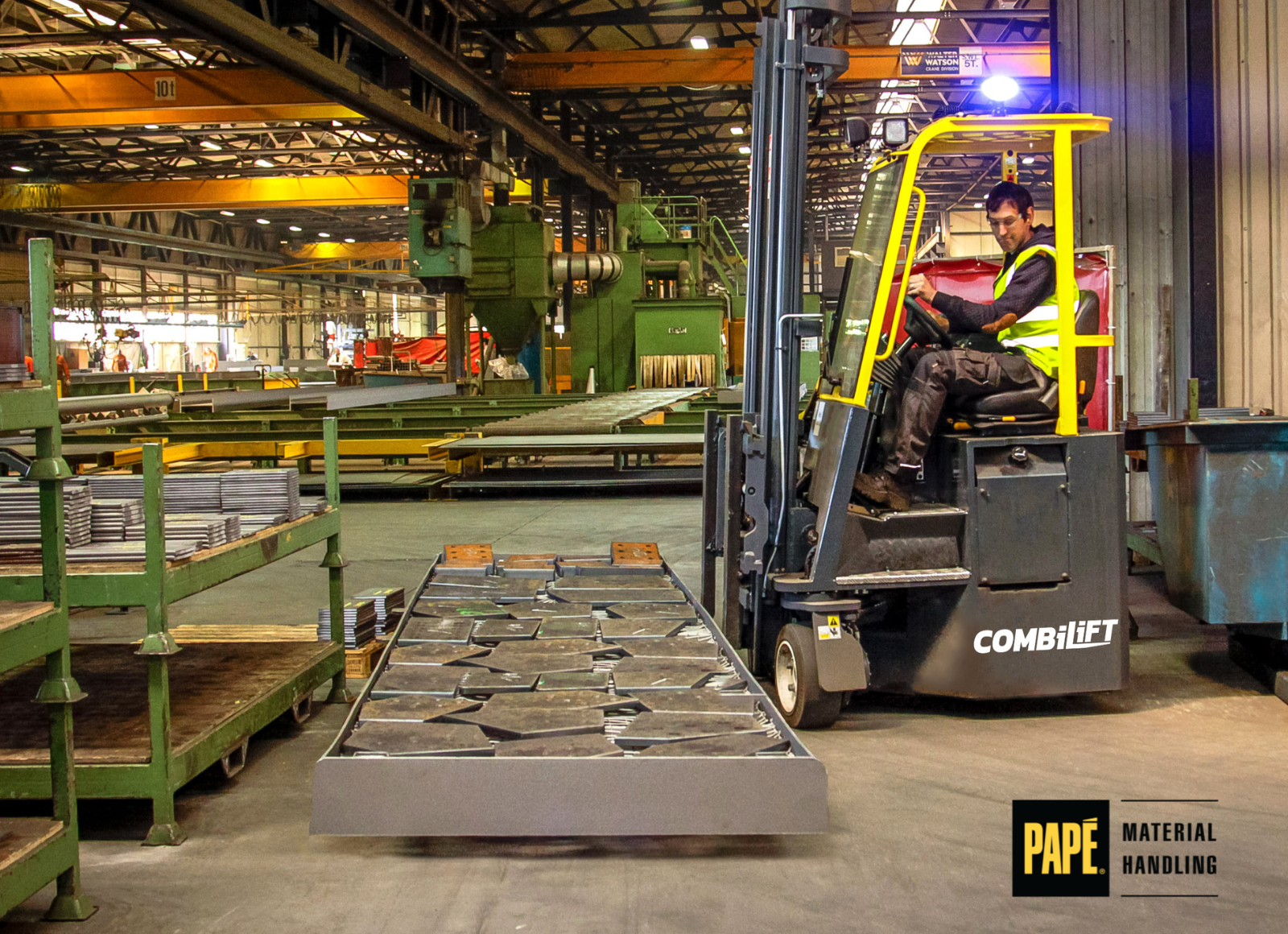
- Combilift and Aisle-Master forklifts for long, bulky loads
- Electric forklifts for indoor operations as they support maneuverability, lower emissions, and efficiency.
- Utility carts and tugs for non-lifting tasks
Get More from Your Existing Warehouse Space
Adding square footage is expensive. In many facilities, a better solution is using the current footprint more effectively. Racking, shelving, mezzanines, conveyors, modular buildings, dock equipment, and workstations can help an organization hold more product while supporting safer, more organized movement.
When warehouse space starts feeling limited, expanding into a new facility is not always the best or most practical solution. In many cases, improving the existing layout can create significant gains in storage capacity, workflow, and operational efficiency.
Papé Material Handling offers complimentary warehouse planning services designed to help operations evaluate their current space and identify opportunities for improvement. Our warehouse engineers assess storage density, traffic flow, equipment movement, and racking layouts to develop solutions tailored to the way the facility actually operates.
Use Technology for Safety and Visibility
Modern warehouse performance relies on visibility. Managers need to see how equipment is being used, where risk is increasing, and where workflow is slowing down. Operators need tools that support awareness in busy environments.
Warehouse technology can improve safety, control, and productivity. Pedestrian awareness systems, operator assistance technologies, and real-time fleet tools give teams more information during daily work. Pedestrian detection systems can alert operators when someone enters a risk zone behind the lift truck, helping teams stay alert around intersections, docks, and shared travel paths.
Technology also supports better decisions. When managers can see utilization, impacts, maintenance history, and operating patterns, they can address small issues before they become expensive interruptions.
Use Automation Where It Solves a Workflow Problem
Automation delivers the most value when it solves a specific workflow challenge. Repetitive travel, labor-intensive transport, limited storage space, high-volume pallet movement, and accuracy issues are strong places to evaluate automated solutions.
Autonomous mobile robots can transport materials between work areas so employees can focus on higher-value tasks. Semi-automated pallet runner systems can support deep lane storage while reducing the need to drive into rack systems. Vertical storage systems and carousels can help save floor space while improving access to parts, tools, and inventory. The key is to define the problem first.
Reduce Downtime with Fleet Management
Every minute of forklift downtime affects productivity, labor efficiency, and throughput. When a forklift is waiting on service, an unavailable battery, or maintenance costs are hard to track, productivity drops. Fleet management gives operations a clearer view of equipment performance and cost. It can support:
- Maintenance scheduling
- Repair history tracking
- Utilization analysis
- Safety and compliance reporting
- Better rental, replacement, and purchasing decisions
With the right data, managers can identify underused equipment, recurring repairs, damage trends, and opportunities to standardize the fleet.
Evaluate Power for Uptime and Cost Control
Batteries, chargers, and charging strategy affect shift planning, labor, floor space, and equipment availability. Lithium-ion batteries support fast charging, on-truck charging, longer lifecycles, and less handling. They also reduce the need for dedicated battery rooms, freeing space for productive warehouse use. Cold storage operations may benefit from specialized battery options.
Build Efficiency One System at a Time
Warehouse efficiency is rarely the result of a single upgrade. It comes from improving layout, equipment, storage, power, technology, and fleet management together.
Contact your local Papé Material Handling to explore warehouse solutions designed to improve productivity, safety, and operational performance.