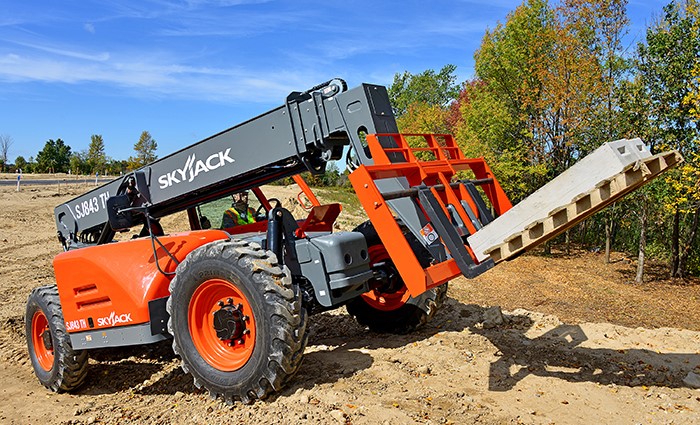
A telehandler is a versatile piece of equipment that is a go-to choice on construction sites, farms, oil fields, and many other job sites where lifting, moving, and placing of heavy materials is required. These machines come in a range of sizes, lift capacities, and offer a variety of features and attachments depending on the model you choose. This Telehandler Size Guide from the experts at Papé Material Handling is designed to help you find the telehandler with the right combination of power, maneuverability, lift capacity and lift height for your specific needs.
Below are the key questions you’ll need to determine answers to before you buy or rent a telehandler.
How much weight do you need to lift?
Determining how much weight you’ll need your telehandler to lift on a regular basis is important to properly assess the size telehandler you will need. Rated capacities on telehandlers can range from 4,000 lbs. up to 15,000 lbs. or more. Load weights are often marked on the load itself or on the shipping documentation. If you aren’t sure and need help determining the approximate weight you’ll need to lift based on materials and dimensions, we can help you figure it out.
How high do you need to lift?
From mini telehandlers to high reach models, the vertical reach of a telehandler can range significantly. We carry options with a maximum lift height of 19’ up to 56’ to meet your needs depending on the type of work you plan to do with your equipment.
How much forward reach would you need?
The horizontal reach of a telehandler is the distinctive feature that sets it apart from a traditional mast forklift. The option to extend the telehandler boom makes it a much more useful machine on a job site with obstacles. A small telehandler may only have a reach of about 10’ but larger models can reach up to 45’.
Understanding Load Lift Charts
Once you know how much, how high, and how far you need to lift your loads, you need to put all of that information together to determine the right size machine for your needs. Telehandler specs can be misleading if you were to simply look at one number. The maximum lift capacity decreases as the boom is extended to maximum lift height or reach.

Using this load chart as an example, if an operator wanted to place a load weighing 4,000 lbs. at a height of 20 feet and a reach of 10 feet, they would be able to safely lift that load at a 40-degree angle. If they wanted to place an 8,000 lb. load using the same reach and height, they would need a bigger telehandler to get the job done.
The load lift chart for each machine can be found in both in the cab and in the operator’s manual for easy reference.
What will you be lifting?
Once you know the right size telehandler for your needs, you can start to look into other features and options. Telehandlers can be equipped with dozens of different attachments depending on what you need to lift. Bale clamps, pallet forks, log handlers, pipe grapplers, buckets, or even a coupler mounted hooks can be fitted to your telehandler to ensure you can accomplish the tasks you need to safely and efficiently. Owning a variety of telehandler attachments increases the types of jobs you can accomplish with your machine.
Other Important Considerations
Jobsite Dimensions
Factoring the job site into your decision making when looking at telehandler models shouldn’t be overlooked. If you are working in an urban environment, for example, you may not be able use a heavy-duty, high-reach telehandler because it may take up more space than you have available. If you need a high capacity solution for narrow or tight workspace conditions, a telehandler may or may not be the right option for you. Contact us to discuss your job site limitations and we can help guide you to the best solution.
Ground Conditions
The ground conditions should also be considered as the weight of a telehandler can be substantial and loose or unstable soil can make use of a heavy machine dangerous. An 8,000 lb. capacity telehandler will weigh about 27,000 lbs. – add in the load weight and you could easily have 35,000 lbs. in motion. To put that amount of weight in perspective, a Toyota Camry weighs about 3,200 lbs., so a loaded telehandler can easily be 10 times the weight of a sedan.
Let Us Help
Buying a new or used telehandler is a big investment no matter the size. Let us help you make the right decision for your business. Our team of equipment experts at Papé Material Handling can help you choose the telehandler specs to meet the needs of your job and your job site. Contact us today with any of your questions or to request a quote.